Falling river, flowing river
With the Kingfisher does he fly
Falling river, flowing river
With the Deschutes he brings new life
Antinous was born in Bythinia, drowned in the Nile River and became a God in its sacred waters, and his cultus was observed and celebrated in the Roman Empire. Many of his modern day devotees, however, are not in those physical locations. We are spread out across the globe, practicing devotion in our own home shrines and altars, situated in a physical place defined by its own unique topography and ecology. This is what we had in mind when The Ekklesía Antínoou offered to host a ritual at Many Gods West this past weekend in Olympia, WA.
Many Gods West is a yearly gathering of polytheists of all sorts. It’s a weekend of presentations, workshops, panels and rituals. The Ekklesía was happy to participate in this year’s conference and host a ritual on Saturday night honoring Antinous and local river spirits, retelling the God’s story in a local setting, giving attendees an opportunity to practice personal devotion to our Deity, and also to receive a ritual purification. All of the feedback we received has been very positive and many people expressed how meaningful the ritual experience was for them. It was wonderful to be able to honor and practice devotion to Antinous and the other Gods present with our wider polytheist community.
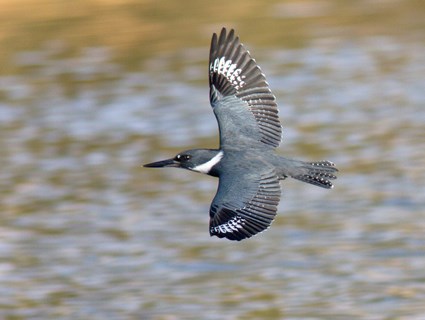 One of our goals with the ritual was to emphasize how Deities who are connected to a specific time and place can be encountered locally, wherever that God’s devotees might be. In this case, we wanted to connect Antinous to the local rivers in and near Olympia, WA where Many Gods West was taking place. Antinous was drowned and became a God in the Nile in Egypt, but we sought to encounter him, along with any other Gods and spirits already present, in the Deschutes River in Washington. To this end, Christodelphia Mythistorima (Sister Krissy Fiction), her partner Dan, Otter, and Jay Logan met at Tumwater Falls on the Deschutes River to introduce themselves to the river and say hello. It was a beautiful day in early July, and there’s a nice trail along the river to the lower falls that we decided to walk together. There were actually quite a few people out and about, but down by the lower falls we managed to sneak off the regular trail and find a spot where the river veers off and forms a kind of secluded pool of still water. Otter collected rocks and built up a small cairn that we used as a makeshift altar. Jay brought milk and honey that we used as an offering to the river. And as we were standing there, two kingfishers fluttered and bobbed and swirled around each other… and then one of them plunged into the water and died. At first, we weren’t sure what was going on. The bird lay in the water and flapped its wings a few times, but soon that stopped and it was apparent that life had left it. Was this an omen? If so, was it good or bad? What did this mean? We were mystified. Jay did a quick bit of a divination and received a positive response. But still, the immediate meaning was elusive.
What resulted from the experience related above was a story. Or more properly, a myth. It’s the retelling of the Antinous story written by Jay, set not on the Nile, but on the Deschutes. The story is true. the story is not true in the literal and factual sense, although some of what is mentioned in the story did actually happen,. It will never appear in a history book. But the story is true nonetheless. We present it here, as one way to honor our Gods, regardless of where they originate, in our own home shrines, in our local forests, in the shadows of our local mountains, and along the banks of our local rivers.
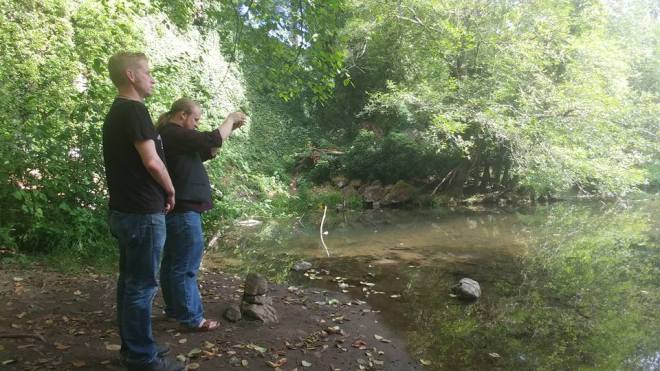
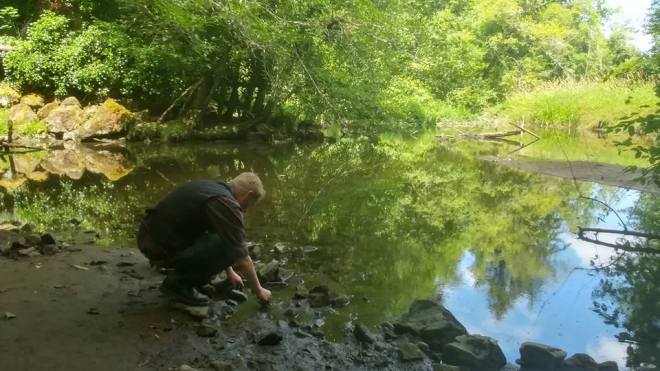
Jay Logan and Otter making an offering to the Deschutes
Antinous and the Kingfisher
– Jay Logan
There was once a young man and a river
Not the Lykos, which runs through Bithynia, the land of his birth
Nor the Alpheiós, running through the mountains of Arcadia, home of his ancestors
Nor the river Tiber, home of the grand city of Rome, whose emperor he dearly loved
Nor do I speak of the Ilisos, near Eleusis, though he witnessed many mysteries there
There was once a young man and a river
Not the Kaystros, home of Artemis, the Great Mother of Ephesus
Nor the Nile, bound to him by fate and necessity
Nor the river Aniene, which runs near his beloved’s villa in Tivoli, where his body now rests
Nor do I speak of the Astura, which fed a temple and collegium dedicated to him and Diana in Lanuvium
There was once a young man and a river
No, the river I speak of is the Deschutes, River of the Falls
The river I speak of is one of falling cascades, known as Pu-kal-bush by the First peoples here
It is the river that feeds these very lands, all around us in the heart of Cascadia
It is the river of cedar and maple; the river of salmon and black bear
There was once a young man and a river
The river was Deschutes, and the young man was Antinous.
Falling river, flowing river
With the Kingfisher does he fly
Falling river, flowing river
With the Deschutes he brings new life
The river is the very heart of Antinous, the beginning and end of him. Wherever those rushing currents flow, the crashing waves upon rock and fallen tree, and the smooth and steady stream – there he is. The Deschutes was no different.
But when he and his beloved Hadrian, once upon a time, came across these waters during the course of their travels, they stumbled across a wasteland. The river was just a trickle, drying, the cedar and maple on its shores wilted, dying.
And the salmon, who were beginning their run, were merely a drop of red in the stream, rather than a healthy river of flowing blood. The land was suffering, and it seemed like there was naught that they could do….
Falling river, flowing river
With the Kingfisher does he fly
Falling river, flowing river
With the Deschutes he brings new life
There was one sight of hope that Hadrian and Antinous found as they made their way along the riverbank – a pair of Kingfishers diving and chasing each other, a brilliant display of striking blue and white that streaked through the air.
The birds were a welcome spectacle amongst all the stagnation, one that helped to lift their spirits. However, it was an ill-omen that they witnessed there along the river. For what they had surmised was a mating display – they being ignorant of the season – soon turned deadly as one bird pierced the heart of the other, which fell into the placid pool before them.
He lay upon his back at first, his wings flapping lazily in the water. Antinous thought, “Surely he must be taking a bath? Birds do do that on occasion, though I have never seen one do so while floating on their back….”
In no time at all, it seemed, the flapping of the wings ceased, the bird’s beak dipping below the water, and all life fled that small body floating there upon the water.
Falling river, flowing river
With the Kingfisher does he fly
Falling river, flowing river
With the Deschutes he brings new life
The evening came to them distraught and despondent. Antinous and Hadrian sought comfort in each other’s arms, there upon the riverbank, and shivered in the summer heat until a dim and restless sleep took them.
Antinous dreamed…. And in that dream he saw a tall young man, dark of features, with long cascading hair falling upon his shoulders. The man stared intently at Antinous and appeared to shout at him, but all Antinous could hear was the roar of water. Suddenly the man rushed towards him. Antinous turned to flee, his heart racing in a fear he did not understand, but the man sped faster than sight, quick as the current and seized him.
Antinous looked into his pleading eyes, eyes the deepest cerulean blue. As he looked up at him, those eyes softened and the man spoke once more, the relaxing sound of a burbling brook. When Antinous still did not express comprehension, the man looked away in despair. Instinctually, Antinous took the man’s face and brought it to his own and gave him a gentle kiss. When their lips met, Antinous’ eyes widened in understanding.
And Antinous woke.
Falling river, flowing river
With the Kingfisher does he fly
Falling river, flowing river
With the Deschutes he brings new life
That understanding did not leave Antinous upon waking, even though the pall of sleep lifted and took away most of the details from the night’s dreaming. He knew that he had spoken with the river, and that the river needed something from him.
The vision distracted Antinous from the world around him, no matter how much Hadrian cajoled him, tried to draw him out of himself with stories of hunting exploits from a bygone era.
As night settled in around them and their fire, Antinous finally broke his silence and told Hadrian of his dream, and what he had decided to do. Hadrian begged him not to – “Just this once, let the river starve! Why must you help the river? Who are they to you?”
But Antinous was resolute: “The River is home to the people here. If the land is lost, what will become of them? What will become of anyone? If there is something that I can do to help, I must. I must.”
Falling river, flowing river
With the Kingfisher does he fly
Falling river, flowing river
With the Deschutes he brings new life
Hadrian embraced Antinous gruffly, giving him an ardent kiss, his beard grazing him with swollen lips. They tumbled to the ground and made love beneath a copse of maples, there along the riverbank, fulfilling a desperate, grasping desire.
Antinous left the embrace of his lover, dozing contentedly, as the moon rose high in the night’s sky. He walked steadily along the river until he found a calm pool deep enough to submerge himself. He swam gently by the soft light of the moon, delighting in the cool waters that played upon his body, even laughing with pleasure at the tickle of plants and what small fish remained to nibble at his toes.
Eventually, though, fate took him. How, we do not know. The only witness that night, the Moon, shrouded herself with clouds in dismay as his thread was about to be cut. Did the current become too fast for him to navigate? Did he rush headlong into giant glacial rock? Did his feet become tangled in some water plant so that he was not able to escape the water’s strength?
We shall never know. His death, as his life, was his own, and all that we can know is that darkness took him, and that he ceased.
Falling river, flowing river
With the Kingfisher does he fly
Falling river, flowing river
With the Deschutes he brings new life
Sleep had lain so heavily upon Hadrian, that he only noticed his lover’s absence at the first of the day’s light. Knowing his Antinous, he searched for him frantically – pushing aside branches, skidding down hills, and scrambling over river rocks in his haste for it to not be true:
“Not his beloved!
Not his Antinous!”
All day Hadrian searched, until at last he found him, washed upon the shore. His body remained remarkably unblemished, his fair skin as lovely as the last time Hadrian gazed upon it. It was as if Antinous was merely sleeping there upon the wet earth.
But as Hadrian lifted his body from the water, Antinous’ head fell back, his damp curls falling back – a blossom snapped at the stem. And again he felt the keen agony of Apollo over the loss of his Hyakinthos. Hadrian brought Antinous’ body close and he wailed and wept, having no care for who might witness his grief – be they creature, man, or god!
And the heavens opened up and wept….
Falling river, flowing river
With the Kingfisher does he fly
Falling river, flowing river
With the Deschutes he brings new life
Seven days and seven nights it rained, a veritable deluge. When the skies cleared on the morning of the eighth day, the land had changed – fresh green leaves growing from the shrubs and trees; a full, rushing current in the riverbed; and there, at last they saw the return of the leaping salmon, filling the river to brimming with their squirming bodies, making it red as blood.
With the storm now passed, Hadrian was at last able to build a funeral pyre for his beloved Antinous.
Ignis corporis infirmat
Ignis sed animae perstat
The fire of the body diminishes
But the fire of the soul endures!
As the fire died down at dawn, Hadrian saw a curious sight – a Kingfisher flying and dancing in circles before him. The sight of that noble bird pierced his heart, for he knew it to be the form of his beloved. He wept anew, this time in joy.
As his tears fell into the water, he prayed to the river, to mighty Deschutes, to give him too the form of the Kingfisher, so that he and his beloved could be reunited. Filled with gratitude and thanksgiving for his lover’s sacrifice, the River granted his prayer.
And so the Day was greeted by the sight of two birds dancing and flying around each other in renewed joy and ecstasy of love’s return. They flew over the land and the river reborn. On and on they flew toward the dawn, seeking new life and new adventures.
There was once a young man and a river
This concludes their story, the river Deschutes, and the young Antinous
Falling river, flowing river
With the Kingfisher does he fly
Falling river, flowing river
With the Deschutes he brings new life
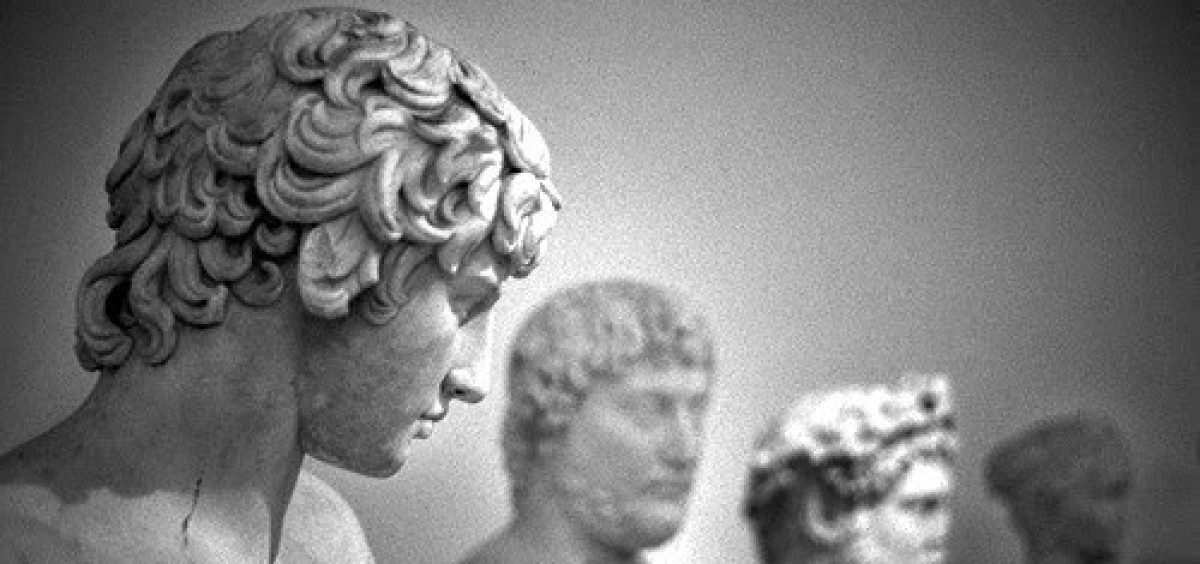
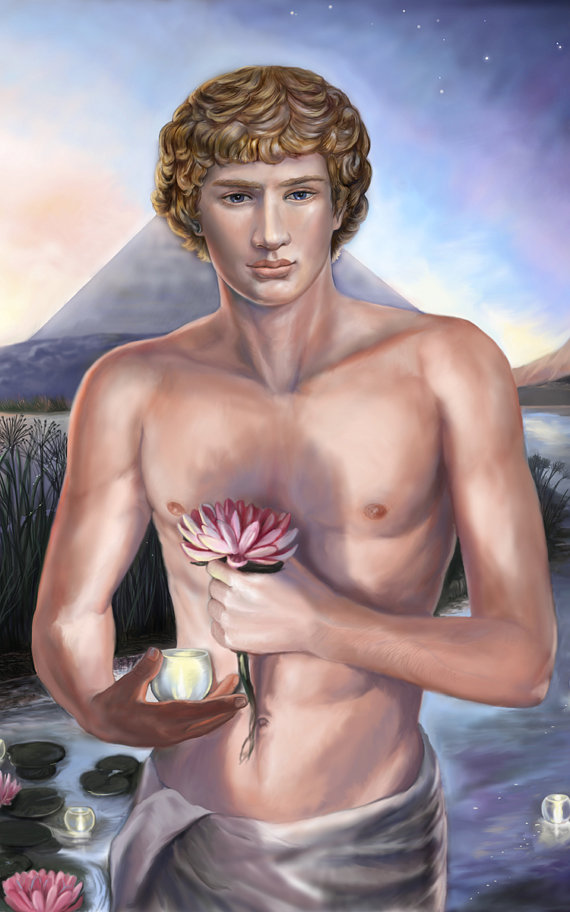
 And he is beautiful. Some might think it is shallow to speak of a god’s beauty and feast the eyes on his naked image, but beauty has power. We call him the Liberator because he liberates; we call him the Navigator because he guides, in life and in death. We call him the Lover because he is beautiful, he is lovable, and he loves those whom he draws to his side.

 Naos Antinoou: A Temple of Antinous