31 Days of Devotion, day 9

What are some common misconceptions about this deity?

There are two answers that come to mind immediately on considering this question. The first, which one sees even in some academic sources, is that Antinous was divinized by Hadrian out of grief and devotion for him. This is simply not the case. Antinous was divinized because he drowned in the Nile. Osiris had become lord of the underworld by dying in the same way, so anyone who shared his death shared his divinity. Many humble ordinary people over the millennia had been deified in that way; Antinous would have been just another of them, served by a local priesthood until his memory died out, if he had not happened to be the beloved of an extremely powerful and wealthy person.

What Hadrian did do was build a city where his beloved’s body was found, endow his priesthood, and promote his worship. It seems to have spread rapidly, even allowing for Hadrian’s influence. It’s because of Hadrian that we have so many surviving images of Antinous, all of them recognizably the same person. It’s because of Hadrian and those who chronicled him that we have Antinous’ name and birthplace, know about their relationship, and know how intensely Hadrian mourned his death. But he did not simply declare his beloved divine, or compel the Senate to do so, in the same way that deceased emperors and their spouses and other relatives were declared divine. Antinous was sometimes called a hero, sometimes a daimon (that is, a spirit), and most often a god, deus or theos, but not divus, like Julius, Augustus, or Hadrian himself.

The second very common misconception about Antinous is that he was and is “a gay god”, or “the gay god”, or “the god of gayness”. I think this is largely a misunderstanding of how sexuality was perceived in the ancient world. Heterosexual and homosexual are concepts not more than 150 years old. Gay as a sexual identity and a subculture is newer than that. From our 21st century perspective, a great many men in ancient Greece and Rome were not gay, but bisexual; they married and fathered children, but also carried on intense emotional and sexual relationships with other, normally younger men. Hadrian entered into a political marriage as part of his rise to Emperor; he remained married to Vibia Sabina, but he was known to have affairs with both women and young men. Whether a great many women followed in the footsteps of Sappho and had passionate affairs with other women while also being dutiful wives and mothers is not recorded (but I like to think they did). The important thing, from the dominant male standpoint, is that the wife was not presenting her husband with children he had not fathered to inherit his name, status, and property.

Certainly Antinous blesses erotic and romantic relationships between men and supports the legal and social acceptance of those relationships. But he seems to have a broader interest in honest erotic and romantic relationships generally, no matter what the combination of genders, and in issues of social justice and equality, whether confined to gay men or queer people or not. Like Dionysus, he is interested in personal and social freedoms, joy and ecstasy, theatre and performance. Like Hermes, he is interested in language, communication, and connection; he also, like Hermes, can be a psychopomp and guide of the dead. Like Apollo, he is interested in healing, in music and poetry, and in oracles and prophecy.

You do not have to be a gay man to worship Antinous. He will not turn you away if you are not. He has much to offer devotees who are interested in any or all of the things that concern him, to anyone who is moved by his beauty. Come to him with a prayer and a simple offering, and he will show you that he is not only beautiful, but benevolent and just.

31 Days of Devotion – Day 8

Discuss Variations on this deity (aspects, regional forms, etc.)

This is an interesting question, as it dovetails closely from the previous day’s prompt. In other words, a deity’s names are often used to describe different aspects or regional forms of a deity. If you were to check out Theoi.com’s titles and epithets section on their excellent biographies of various Hellenic gods and goddesses, you’ll see various titles that relate to a god’s function or area of influence, as well as places where they were worshipped. For instance, Demeter is Chthonia, ‘of the Earth’, as well as Eleusinia, ‘of Eleusis.’

One might be tempted to write today off, say been there, done that, but not us, oh erstwhile reader! It occurs to me that while we admirably covered Antinous’ various qualities and modern epithets, we did not much cover his regional forms and variations, so that’s where we’ll attack this question.

As we’ve learned so far through this devotional process, the historical cult of Antinous was found across the reaches of the Roman Empire, and his form often varied depending on where he was being worshipped and oftentimes which deity he was being syncretized
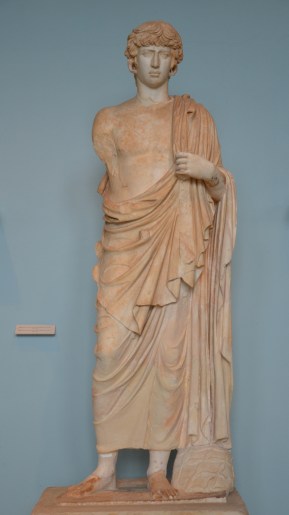
with. You see, while Antinous is always and everywhere himself, he often takes on the functions and characteristics of other deities. When he was in Antinoöpolis and other areas of Egypt, as well as in Hadrian’s own villa of Tivoli, Antinous was often portrayed as Antinous-Osiris. In the sanctuary of Delphi, a site sacred to Apollo, we find a statue of Antinous depicted in a way that Apollo often was, as a divine ephebe, and we can see upon closer inspection of his head that there are holes that were used to attach a bronze laurel wreath.

antinous-of-delphi6

23770437800_c75b1845c9_b


At Eleusis, sacred site of the Eleusinian Mysteries devoted to Demeter and Persephone, we find another depiction of Antinous, this time as Asklepios, with an omphalos at his feet, which likely stood at the entrance to the Sanctuary of Demeter, bidding health and good fortune to those travellers coming to Eleusis (Fox, 2014, p.44). And at Lanuvium, a city which held a funerary society dedicated to Diana and Antinous, we find a most splendid depiction of Antinous as Silvanus, which has the curious fate of having been rediscovered in the modern era buried in a field.

3509

antinous_dionysos_terme


Antinous adapts to whereever he finds himself, and sometimes through whichever deity he is most needed at any given point. Back in August we shared a story of how Antinous related to a river local to a number of practioners in the Pacific Northwest, and we invite you to look likewise.

How does Antinous manifest where you are in the world? In what aspects does he come to you?

References

Fox, Tatiana Eileen. (2014). “The Cult of Antinous and the Response of the Greek East to Hadrian’s Creation of a God”. Unpublished Thesis, Ohio University.

31 Days of Devotion, day 7

Discuss some of this deity’s names and epithets.

In May of 2015, I wrote a series of hymns to Antinous that are available here at the Naos. I crafted many of them around the epithets and titles of the god, some around his relationships with other deities. I hope the reader will be satisfied if I link to some of those hymns as my meditations on today’s topic.

Hymn II: To Antinous the Liberator

Hymn III: To Antinous the Navigator

Hymn IV: To Antinous the Lover

Hymn XXV: To Antinous Agathos Daimon

Hymn XXVI: To Antinous Heros

Hymn XXVII: To Antinous Homo Deus

Hymn XXIX: To Antinous Deus Amabilis

Hymn XXX: To Antinous Deus Frugiferus

I invite my readers to share their own reflections on the titles of Antinous that are the most meaningful to them!

31 Days of Devotion, day 6

What other deities and entities are associated with this deity?

To answer this question with, “All of them” would be easy and not wholly incorrect. Antinous has the gift of making connections among gods and between gods and mortals. He is often described as a “gateway god”, someone who attracts people to polytheism by their worship of him.

However, a facile answer doesn’t make for a very interesting read. Therefore, I’ll offer my opinion on the deities and entities that are definitely associated with Antinous.

First and foremost, of course, there is Hadrian. Without Hadrian’s relationship to Antinous, we would likely know nothing of the Greek youth from Bithynia, even if he had travelled to Egypt and drowned in the Nile under other circumstances. Antinous still would have been deified, but his cult would have been confined to a small locale instead of promoted around the Empire. Without Hadrian, we would have no statues to immortalize Antinous’ beauty, and one less model of an erotic, even romantic relationship that in some ways broke the rules for such relationships by its intensity.

Along with Hadrian I must mention his wife, Sabina. That may seem strange to our sensibilities, if we are thinking of Sabina as the wronged wife of a man having an affair with a younger man. A few considerations have helped me to understand Sabina’s importance. First, that categories like heterosexual and homosexual really do not apply in the ancient world; in both Greek and Roman culture, adult men could take whatever partners they wished, male, female, slave, free, as long as they were appropriately dominant. The double standard wasn’t a hypocrisy, it was simply a fact; men were not under the same sexual constraints as women.

Second, that it would have been simple for Hadrian, once established as Emperor, to divorce Sabina and replace her with another wife, or no wife. He did not. And third, he ordered her divinization, which along with their continued marriage leads me to believe that he had affection and respect for her and found value in their partnership. The Obelisk of Antinous portrays the divinized youth praying for Hadrian and Sabina together as rulers of Egypt and the Empire; I think his worshippers should do no less than honor them together in the same way.

After Hadrian and Sabina, Antinous’ closest connections are with the four deities with whom he was most often syncretized: Osiris, Dionysus, Hermes, and Apollo. He became Osirantinous upon his death in the sacred river. The Greeks had already syncretized or equated Dionysus with Osiris, and much of Antinous’s iconography borrows from the traditional depictions of Dionysus. Antinous was syncretized with Hermes as a messenger, communicator, interpreter among the gods, and with Apollo as an oracle, healer, and inspirer. With the exception of Osiris, these gods are all portrayed as youths, the children of Zeus rather than the first generation of Olympians.

Besides Sabina, the goddesses with whom Antinous has the closest connection are Diana, especially at Lanuvium, where a burial society was dedicated to both of them, and Juno, who was also worshipped at Lanuvium. I find it interesting that both of these goddesses support female sovereignty, Diana the virgin huntress, refusing the ties of marriage, and Juno the queen of heaven who gave her name to the divine spirit within every woman.

Those are my choices for the deities most closely associated with Antinous. But I still stand by my original answer: The deities connected to Antinous? All of them.

31 Days of Devotion, day 5

Who are the ancestors, relatives, children of this deity?

POEM: The genealogy of Antinous

O Antinous, beautiful, just, benevolent,
son of Mantinoe, daughter of Bithynia,
daughter of Arcadia, son of Hermes,
son of Maia, daughter of Atlas and Pleione,
son of Zeus, son of Kronos and Rhea,
children of Gaia and Ouranos: Antinous,
Greekling, Bithynian boy, may your blessing
be on my ancestors, my forefathers and foremothers,
the queer aunts and the honorary uncles,
my mentors and teachers, in the flesh and in the spirit.

Antinous, Liberator, Navigator, Lover,
father of Panpsyche, father of Panhyle,
parent of All-Soul and All-Body
along with Pan and the seventy-six others
who brought forth the new gods, the first
of the Tetrad, who joined together in union
and brought forth Paneros, metagender,
All-Love, who joined with eir parents and
engendered Pancrates, All-Powerful One
of four names, who in darkness and fire
caused the generation of Panprosdexia,
the All-Accepting One who leads home
the lost: Antinous, Panpsyche, Panhyle,
Paneros, Paneris All-Strife, meet and mate
of Paneros, Pancrates, Panprosdexia,
bless and protect my children, my descendants,
whomsoever I have taught, or helped,
or inspired, guard them, guide, lead them
into love in all its freedom and fullness,
and even so do the same for me.

(For further information on the deities of the Tetrad, I refer you to All-Soul, All-Body, All-Love, All-Power: A TransMythology by P. Sufenas Virius Lupus and to eir blog.)

31 Days of Devotion, day 4

Share a favorite myth or myths of this deity.

The ancient cultus of Antinous did not leave behind a lot of myths. It left many physical artifacts, some texts, and a few historical facts. Antinous was syncretized with many deities, principally Osiris, Dionysus, Apollon, and Hermes, so to some extent, their myths are also his.

But the contemporary cultus of Antinous is generating new mythology, organically. To demonstrate this, I have to abandon discretion and point to my own writing.

A year ago today, as it happens, I wrote the opening scene of a story about the gods. It started, as many stories have, with a simple “What if?”–“What if Hel, goddess of the dead, visited Hades, god of the dead, in his kingdom, while Persephone was with her mother?” It began with an unexpected visit from the northern goddess, distracting Hades from missing his wife, and ended with the birth of Melinoe, the child whom Orphic tradition says that Zeus fathered on Persephone by disguising himself as Hades, and the decision arrived at by Persephone, Hades, and Demeter to foster Melinoe with Hel, away from the eyes of Zeus.

I posted the story in sections as I wrote it, through October and into November. After it was done, I was seized almost at once with the idea of a sequel: That a day would come when Antinous would be called upon to fetch Melinoe out of Hel and bring her home to her parents. Antinous as the Navigator pilots the Boat of Millions of Years, which has the property of being able to visit any and every form of the afterlife. (That idea is itself a new myth, or as many people would call it, UPG–unverified personal gnosis.) It would be simple for him to visit the northern realm of the dead, then return to the Greek or Mediterranean realm.

Thinking further about this, I remembered that the time of Antinous as Navigator begins when a particular star becomes visible in the Northern Hemisphere, at the end of January. Therefore the river on which his Boat sails is the river of the stars, the Milky Way, or the constellations. I began to lay out a plan for the story in which Antinous and Melinoe visit each sign of the Zodiac and encounter different deities and spirits there.

I had not written very much of the story when I realized that I was, essentially, writing a romance, a story in which the male and female protagonists were going to pair up. Some divination confirmed that, yes, this is what the gods were trying to tell me, that I should ship Antinous/Melinoe, as we say in fannish circles, and that there was a particular direction the story was headed that was of revelatory importance.

The writing of this work has moved very slowly, and I don’t want to say much more about it for fear of spoilers. I don’t write about this to claim any special importance for myself. It’s just that I am a devotee of Antinous and a writer, and writing is how I arrive at the truth. I think of my stories as fanfiction about the gods, and call them mythfic; there is really no reason except humility, or just a fear of reprisal, for me not to call them myths. I am creating new myths, which the gods give me through my gifts as a storyteller. There is no reason why people should not dream new myths of Antinous by night, or tease them out by divination, or discover them through painting or sculpting the god, or in other ways of making art or entering altered states. If the gods are truly alive and active, then their myths are not a closed canon like the Bible, a finished body of work, but rather an open-source text that can be added to, edited, revised, rebooted, and continued, indefinitely. It is a privilege and a joy to do so.

31 Days of Devotion, Day 3

What are some symbols and icons of this deity?

He is the moon rising in its fullness, Endymion
sleeping in the cave while Selene contemplates him,
and he is the dark moon hiding, concealed in
intimacy with the Sun.

He is the red lotus rising out of blood and mud,
death and failure, unexpected fertility and vitality
concealed in the muck of life. He is the spider
weaving connections between star and star,
god and mortal, heaven and earth.

He is the spear carrier who defeats the boar
and the lion and charges into the dark, and
the clear-sighted helmsman who guides a boat
through infinity, and the lover who is always ready
to share a beer, a glass of wine, a long conversation
in a quiet corner, a dance amid flashing lights and glitter.

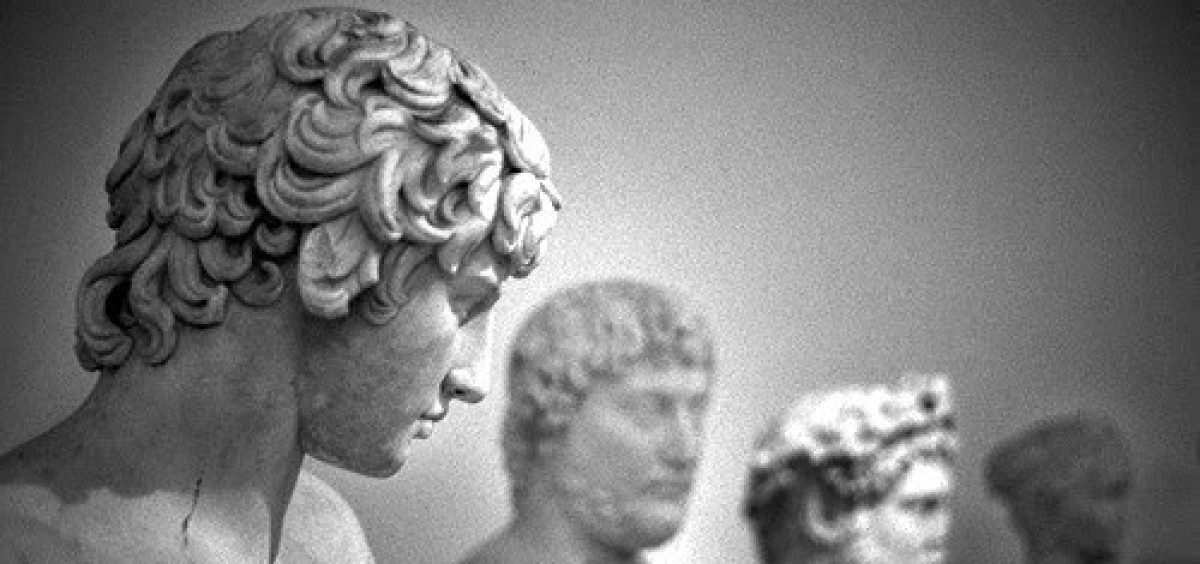
He is the face of beauty itself, the embodiment of youth,
the curling hair, the serious gaze, the lush mouth,
the broad shoulders, the round buttock, the confidence
of embodiment, the crowned and conquering child:

He is Antinous.

31 Days of Devotion, Day 2

How did you become first aware of this deity?

Anyone with any interest in ancient Rome has probably heard of Antinous. The phrase “Hadrian and Antinous” is like “bread and butter”. One of Adrienne Rich’s early poems concerns Antinous and his relationship to the Emperor. I’ve been interested in ancient Rome since I was a child; it must be decades since I first heard of Antinous.

It was not until fairly recently, though, that I heard of him as a god, a being who had been worshipped following his early death and was being worshipped again today. Between 2002 and 2012, I was pretty active on Livejournal, with connections to both fannish and pagan/polytheist communities. Somewhere during that time, I made a connection with P. Sufenas Virius Lupus on LJ and began to read eir WordPress blog, the Aedicula Antinoi, back when it was still new.

Antinous seems to me to be a god who is active through social media, who has no qualms about using it to reach his people and bring them together. I once had a Facebook chat with two other Antinoans who were twelve hours apart in time zones; I was six hours behind one and six hours ahead of the other, exactly in between.

PSVL once pointed out in an interview (and maybe more than once–I’m not sure I can identify which interview it was) that while Antinous is well known as a minor figure of ancient history, Roman history, queer history, he is not well known as a god. One of my aims as a blogger is to make the Bithynian Boy better known for the divinity he is.

How did you, dear readers, discover Antinous as the Beautiful God?

A month for Antinous

All my online feeds right now are full of the proclamation of fall: Pumpkins, skeletons, scarves and sweaters, hot flavored beverages, Tim Burton films. Here at the Naos, however, our thoughts turn to the Bithynian Boy (not that we despise seasonal beverages). October is the last month of the sacred calendar for us, and as it ends, a new year begins with the Sacred Nights, the festival of Antinous’ death and deification.

In celebration of this holy time, and in the interests of providing more content, we’ve decided to undertake a meme: 31 Days of Devotion. Each day of this month, at least one of the bloggers here will post a devotional writing prompt and their response to it. I invite our readers to post their own reflections in comments.

I’m going to start off the month with the first prompt: Write a basic introduction to the deity.

The bare facts about Antinous are easily summarized and no doubt familiar to regular readers of this blog. He was a Greek youth from Bithynia in what is now Turkey, companion and lover to the Emperor Hadrian, who drowned in the Nile at the age of about nineteen. In accordance with ancient Egyptian custom, he was deified; those who drowned in the Nile, like Osiris, became Osiris. Because he was the beloved of an emperor, a city was built on the site where his body was discovered and his worship was promoted around the Empire. He was worshipped for about 200 years before Christianity was promoted to official status; he was never completely forgotten, especially by queer people, because Greek and Latin literature were not forgotten, and perhaps because there are many statues of him that have survived in good condition. He had a face, a body, a gaze that is not easily forgotten.

Now you know who Antinous was, and is. The more interesting question, I think, is why Antinous. Why has his worship been revived? What does he have to offer us today? I can only answer that question for myself, really. I can tell you why I worship him and what he offers me.

For me, Antinous is the God of Welcome. When I first approached him, I had heard many people say that we don’t choose the gods, they choose us. People talked about being tapped, or called, or swept away. They wrote about knowing since childhood that a particular god or goddess owned them and claimed their service. I had none of those experiences. I only knew I had been reading about this beautiful boy who was a god and wanted to get closer to him. When I began to say daily prayers, to offer incense and lights and plain water, he welcomed me. I was aware of his presence and his good will and his willingness to respond.

Many people have called Antinous a gateway god, and yes, that’s meant to sound like “gateway drug”. He is syncretized with Hermes, after all, the messenger and mediator of the gods. As I began to celebrate festivals on his calendar, I made connections with other gods, principally the gods of Rome, but also Glykon, the serpent god who might also be a sock puppet, and the Tetrad++, a group of new deities who can be called Antinous’ grandchildren. Antinous was my gateway to polytheist practice, to my panthon, and to deities who didn’t just welcome me, but actually picked me, recognized me as Theirs.

Antinous is a god who cares about many of the things I care about. He offers healing and inspires poetry and prophecy, like Apollon. He liberates people from both inhibitions and oppression, like Dionysus. He cares about same-sex relationships, about queer people (I am one), about erotic relationships of all kinds. He cares about justice and equality, about the sexuality of adolescents, about creative work and joyful living. He inspires me to do well, work well, act rightly, according to the values and ethics I already espoused, which he shares with me. To worship Antinous, for me, is in some ways like having a supervisor I work with extremely well in a job that I love to do. We want the same things.  I feel good and right putting my talents at his disposal.

9e847b085dc8494226401cc0a20b9226And he is beautiful. Some might think it is shallow to speak of a god’s beauty and feast the eyes on his naked image, but beauty has power. We call him the Liberator because he liberates; we call him the Navigator because he guides, in life and in death. We call him the Lover because he is beautiful, he is lovable, and he loves those whom he draws to his side.