31 Days of Devotion, Day 19

What quality or qualities of Antinous do you most admire?

Greetings!  This is Christodelphia Mythistórima, aka Sister Krissy Fiction.  I’m one of the Magistrates of the Ekklesía Antínoou, and I’m excited to be able to finally have the opportunity to contribute to this series of blog posts.  I’ve actually been off gallivanting around on a cruise to the Mexican Riviera for my honeymoon, so I guess I have an excuse, but I’m still happy to be able to move into contribute here as we move towards the Sacred Nights of Antinous together.

Today’s topic is about the qualities of Antinous that I admire most.  This might be something of an indirect answer, but the best way I can think of answering this is by talking about what it was that drew me to Antinous in the first place.  That initial pull did come from my interest in his homoerotic relationship as companion and lover to Hadrian.  As a gay man who was exploring Paganism, most of the gods I was becoming familiar were introduced to me though a standard Neopagan or Wiccan format.  That is to say, I was familiar with a Pagan paradigm that was mostly heteronormative, dualistic, and fertility focused.  To be sure, I was always made to feel welcome as a gay man within that paradigm, but there was always an adjustment in how I had to relate to the gods I was encountering.  One common suggestion was to relate to the God and the Goddess as the unity of masculine and feminine within myself.  That works well for lots of people, but as a man who loves men I resonated with seeing a similar type of relationship to the kinds of relationships I experience reflected in Hadrian and Antinous.  That was the initial quality that I admired that drew my interest in.

It wasn’t the only quality that that kept me interested.  A second quality that to this day I still find to be one of the most profound aspects of devotion to Antinous and a great Mystery, is that Antinous was an historical human being who experienced apotheosis and became a god.  Antinous drowned in the Nile River and by nature of the Nile’s status as a holy river, he was divinized.  Ironically, this is sometimes mentioned as a negative by critics.  “Antinous isn’t a real god because he used to be a normal human being.”  However, I think his apotheosis is a profound truth that points to our own divinity and ability to transcend our material world and is definitely one the qualities of Antinous that I have a deep appreciation for.

Truth be told, I could continue to list many different qualities of Antinous and why I find meaning in those qualities.  I find that the longer I practice devotion to the God, the more I learn about him and the more there is to delve into.  However, I’ll finish with one more quality, and that is the nature of Antinous as a syncretic god.  From the moment Antinous became a god, syncretism played an important part of who he is.  After deification, Antinous was syncretized with and depicted as the god Osiris, Dionysos, Hermes, as well as many, many others.  One of my favorite parts of many of the public rituals that have been hosted by the Ekklesía Antínoou over the years in a section we has been called the “Opening of the Pantheon”.  We sometimes have lightheartedly called it the “God Party”.  It’s the part of the ritual where we invite any deities from other pantheons that might be present to be welcome at the ritual.  This points back to the nature of Antinous being syncretized with different gods from different cultural backgrounds, but also Hadrian and Antinous’ fondness for spiritual pursuits and their openness to gods and goddesses from many different places.  It’s a quality that I feel carries over into the respect that the Ekklesía Antínoou has for polytheism as a whole, and for individual traditions regardless of where their historical origin is.

What calls you to Antinous?
31 Days of Devotion, day 18

How does this deity stand in terms of gender and sexuality?

I can answer this question succinctly and well by reiterating what Sr. Christodelphia Mythistórima wrote back in August: “We strongly affirm that any person, regardless of sexual orientation, gender, gender identity, ethnic origin, age, culture, disabilities, nationality, race, or socioeconomic status, may approach Antinous directly and worship him as they see fit, without recourse…” to any group or individual. Antinous himself is male, or masculine (deities do have gender), but he is cool with everybody, and so are we.

31 Days of Devotion, day 17

How does this deity relate to other gods and other pantheons?

Hail, Antinous, God of Peaceful Connections!
In your Boat of Millions of Years you traverse
the otherworlds, welcome in every port.
At your table every god is welcome, every soul,
all who come with good will to the party you host.
Osiris and Isis, Horus and Set, alike sit down
to feast with you; Hera and Zeus arrive together
and mind their manners. Odin and Loki share
a cup, and there is food enough for the Dagda
and all the Danaan hosts. Yeshua sits down
with Shiva and Siddhartha for a long conversation
and everyone goes home happy from your presence,
Antinous, blessed host, when the party is done.

31 Days of Devotion, day 16

How do you think this deity represents the values of their pantheon and cultural origins?

The cult of Antinous is unusual in that it crosses the streams of three different religious cultures: Egyptian, Hellenic, and Roman. Antinous looks a little different through each of these three lenses.

In Egypt, Antinous embodies what I think of as the egalitarian strain in ancient Kemetic religion. It is likely that all the rites of mummification, the ritual Opening of the Mouth, the “Book of the Dead” that guided the deceased safely into the afterlife were originally applied only to Pharaoh and perhaps other members of the royal family. Gradually, however, over the course of centuries, they became normative for everyone, although the extent of one’s funerary rites no doubt depended, as it does today, on how much one’s family could afford to spend on it.

Yet at the same time, those who drowned in the Nile were, for centuries, perhaps millenia, accepted as gods no matter what their status in mortal life. Even a foreigner like Antinous could become one with Osiris. It is likely that his body was embalmed in the traditional way and buried according to Egyptian custom.

In Greece, Antinous’ life and death resonate with a tradition we might call “Flower Heroes”. These Flower Heroes are beautiful mortal youths, often loved by gods, who die untimely and are transfigured into flowers, such as Hyakinthos (the hyacinth), Narcissus (the daffodil), and Krokos (the crocus). The erotic love of a god for a mortal youth recalled the erotic partnership of erastes and eromenos, older man and younger man, which came to an end when the youth became a man himself.

Antinous inverts this tradition, however. His sacred flower, the red Nile lotus, blooms not from his body but from the blood of the lion which he failed to kill. His erastes Hadrian is a powerful older man, but only mortal, while Antinous in death becomes not only a hero but a god, able to bless and even divinize Hadrian by his power.

Antinous seems not to fit very neatly into Roman religious traditions. The deification of the imperial family after death was not an old tradition, as Roman traditions went, and it applied only to them; Hadrian could not simply proclaim Antinous divus on the strength of their relationship. His relationship with the younger man was, itself, one of the ways in which his temperament was more Greek than Roman, like his preference for wearing a beard.

There was, however, a class of deities called Semones, among whom were very old, very Roman gods such as Vertumnus, Faunus, Picus, and the eponymous Semo Sancus, who were held to have been mortal once and become gods. It would not be out of bounds to consider Antinous one of the Semones, a reminder that the boundaries between gods and humans were not impermeable in Roman thought. That gods and humans are not eternally distinct, that humans can become divine and gods become human, is, in my opinion, one of the chief mysteries of the worship of Antinous, as of another late-coming god in the Roman empire, a Galilean fellow named Yeshua.

31 Days of Devotion, day 15

Are there any mundane practices that are associated with this deity?

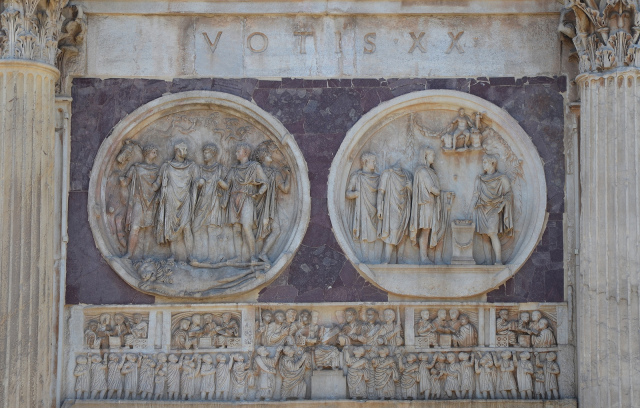
Unlike, for example, Hephaistos and Athena, Antinous was not associated with any particular profession or activity, nor with a stage of life like Hera with marriage, Artemis with women in childbirth. We do know that Hadrian enjoyed hunting and Antinous hunted with him. Three major hunting expeditions are attested by Hadrian’s sections on the Arch of Constantine and appear in the calendar of Antinous’ festivals: The Venatio Ursae or Bear Hunt on April 21st, the Venatio Apri or Boar Hunt on May 1st, and the Venatio Leonis or Lion Hunt on August 21st. Hadrian dedicated the skin of a bear he had hunted to Aphrodite and Eros in Thespia, with a prayer for a lover; soon after, the young Antinous came to court and captured Hadrian’s affections. The Boar Hunt is associated with the sensual and sexual pleasures of May Day, and the Lion Hunt, where Antinous nearly died in confrontation with the beast, is an occasion of examining one’s failures and then making a fresh start, inspired by the red lotus that bloomed from the lion’s blood.

31 Days of Devotion, day 14

Has worship of this deity changed in modern times?

The short answer to this question has to be, “Yes.” There is no god who is worshipped the same way now as eighteen hundred years ago, including Jesus and his Father. Religious traditions change, even when they are unbroken and have living worshippers conserving them, as in India or Japan.

Antinous nowadays has no temples or other trappings of public, institutionalized religion, only shrines in homes, at festivals, and virtually, online. Devotees celebrate the Megala Antinoeia with artistic contests rather than large-scale athletic competitions. No doubt animal sacrifices were made to him, serving as communal meals for the god and his people to enjoy together; nowadays smaller food offerings, works of art, songs, dances, and creative writing are more usual, along with candles and incense, gemstones and jewelry, flowers, wine, and even plain water.

Many devotees of the god worship him in solitary rites, being geographically distant from other devotees, which was probably not the norm in ancient times. Not only are we lacking public temples, we don’t live in households that all worship together. We do have the virtual fellowship of the Internet to console us; without it, I personally would not know my fellow Antinoans at all, nor even know that Antinous had a living cultus.

It’s not our goal simply to revive or reconstruct the worship of the god in the same form that it was once carried on. It is our goal to be as authentic as we can in our forms and spirit while building something that will go forward into the future.

31 Days of Devotion, day 13

What modern cultural issues, if any, are closest to this deity’s heart?

After repeated assertions in my postings here that Antinous is not simply a gay god, or a god of being gay, or a god for gay men, I must now seemingly reverse myself and say that the welfare of gay men is a cultural issue with which he is very much concerned. Antinous’ relationship in mortal life with Hadrian is not something that simply vanished or became insignificant upon his deification. He was involved in a sexual relationship with another, older man which we believe to have been a loving one, sanctioned by classical Greek customs; he was eromenos to Hadrian’s erastes. He continues to be concerned and involved with men who love other men.

However, it is not only men who love men who concern the god, but women who love women, and people who love people. Antinous is a champion of sexual freedom, of equality in loving relationships, of justice for all genders, all sexualities, all expressions of eros. He is as much a defender of the battered wife who leaves her abusive husband as of the queer teenager banished from their home by abusive parents. Queer people, whether gay or lesbian, asexual, transgender, nonbinary, bisexual, or whatever, are Antinous’ people, whom he loves and protects.

31 Days of Devotion, day 12

What are some places associated with this deity and their worship?

POEM: An Antinoan Geography

antinoe006


Born in Bithynia by the river Rhebas,
in Rome by the Tiber you won the favor of Hadrian;
with him you saw the Mystery in Eleusis
and won a place amongst the happy dead.
In the Nile in Egypt you met death and destiny
and became Osiris, a god in truth. There
Hadrian raised a city in your honor, between
the town of Thoth and the village of Bes,
where the water yielded your body,
holy Antinoopolis, and in his villa at Tibur
he enshrined your memory, youth that he loved.
Where were you buried? We do not know.
But you live as god, Antinous of Bithynia,
and wherever rivers flow, the Nile is remembered,
your presence is felt, your name is praised.

31 Days of Devotion, day 11

Talk about the deity’s festivals, days, and sacred times.

One of the reasons your humble bloggers here at the Naos decided to do the devotional meme this month is that October is both the end and the beginning of the sacred year for devotees of Antinous. On the 24th of October, the Sacred Nights commence, the nine days that mourn Antinous’ death and celebrate his deification. On the 24th, we remember the death of Osiris, whose deification became the pattern for Antinous’s. On the 25th, we celebrate all the goddesses, especially Isis and Nephthys and others who lose those dearest to them, on the Panthea. The 26th brings the Ophidia, a day which honors the serpent deities, among them Glykon, the Serpent Path of Antinoan mysticism, and the mystery of deification or apotheosis in general. The 27th faces the mystery of the Ananke Antinoou, that is, his fate or destiny, the necessity and yet seeming randomness of his death. The theme of this day is that there was likely no warning, nothing unusual about this day at all–but it was his last in mortal life.

On the 28th of October, we cover the images and mourn his death. We don’t know exactly how he died, what brought him to the river, what circumstances took the young man’s life; we only know that it did happen. On the 29th, we ponder Antinous in the Underworld and remember that while he was missing from the people who loved him, he was an initiate of the Mysteries at Eleusis, welcomed by Persephone. October 30th is Foundation Day, arguably the most important date of the sacred year; it is the day on which the body of Antinous was recovered. Hadrian grieved him publicly and declared his intention to found a city in his beloved’s honor; worshippers today observe it as a liturgical new year’s day and as the founding date of the renewed cultus.

October 31st and November 1st celebrate Antinous Triumphant and Antinous the Liberator respectively. Antinous is not merely one of the justified dead, initiated into the Mysteries; he has become a god. As the darkness of winter deepens, he will confront the constrictive powers of the underworld and defeat them, to emerge as the Navigator in the spring.

On November 27th, we celebrate Antinous’ birthday as a mortal (and yes, a lot of us sing “Happy Birthday” to the god). In December, we observe the feasts of the Roman Saturnalia, from the 17th to the 23rd, culminating in the feast of Antinous Dionysus on the 21st, close to the Winter Solstice. On January 21st, when the Sun enters Aquarius, we recall the syncretization of Antinous with Ganymede, whose myth parallels Antinous’ so closely, and then on the 29th, we hail the Stella Antinoi, the Star of Antinous, which appears in the constellation of Aquila. At this time Antinous ascends to the heavens as the Navigator, piloting his Boat of Millions of Years through the night skies.

The next major feast for Antinous occurs in April, the Megala Antinoeia on the 21st. At this time sacred games, including poetry contests, were celebrated in his city of Antinopolis, and we begin to celebrate the god’s aspect as Lover. Modern devotees frequently observe this feast with an agon, an artistic contest to which one can submit poetry, prose, artwork, or music in the god’s honor. In ancient times, the winner of the games was honored with a crown of the sacred red lotuses.

On June 21st, near to the Summer Solstice, we commemorate Antinous Apollon. July 16th brings the Antinoan Arbor Day, a celebration of his syncretism with Silvanus, the god of trees and woods. We also remember the visit of Hadrian to Britain during which he inaugurated construction of the great wall that bears his name. July 31st is a day for honoring Antinous’ syncretism with river deities such as the Nile, the Alpheios, one’s local rivers.

On August 21st and 22d, we celebrate the paradoxical festivals of the Lion Hunt and the Red Lotus. Hadrian and Antinous did a good deal of hunting for sport; on this occasion, they chased down a lion which had been attacking people. Antinous faced the beast without sufficient preparation and might have been killed had not Hadrian intervened. He was ashamed of his failure, yet the rare red lotus of the Nile bloomed out of the lion’s blood on the river bank. On the first day we examine ourselves and admit to our failures; on the second, we welcome and grasp the possibility of a new beginning, change, and growth.

On September 21st, close to the Autumnal Equinox, we commemorate the Eleusinian Mysteries, of which both Hadrian and Antinous were initiates. This commemoration is balanced at the Vernal Equinox by the Apotheosis of Sabina, wife of Hadrian. And so we approach the Sacred Nights again as the days grow shorter and the nights lengthen.
I have attempted to keep this post shorter than a book by mentioning only those festivals that concern Antinous first and foremost. There are also festivals honoring Hadrian and other members of the Imperial family, feasts for the gods of Rome such as the Lupercalia and the Megalesia, and days to honor the Sancti or spiritual ancestors of the tradition. In observing the feasts of Antinous, we participate in his death and deification, confront and conquer the forces that oppress and inhibit us, ascend into our potential, and celebrate the joys of a life of love, creative activity, and the blessings of pleasure.

31 Days of Devotion, day 10

What sort of offerings does this deity like?

Bring him red flowers for the red lotus that bloomed
where the lion fell. Bring him blood oranges, shocking
and sweet. Amber and storax, balsam fir and pine
smell like his curling hair. Wine tastes of his mouth,
but pure water refreshes all thirsts. Heap amethysts
and rose quartz, flourites and lapis around his shrine.
Play the music you will sing with and dance to, open
your mouth, your arms, your heart. Light a single candle
and call on his name, Antinous, Antinous, beautiful,
benevolent, just, and he will smile and turn toward you
and listen.